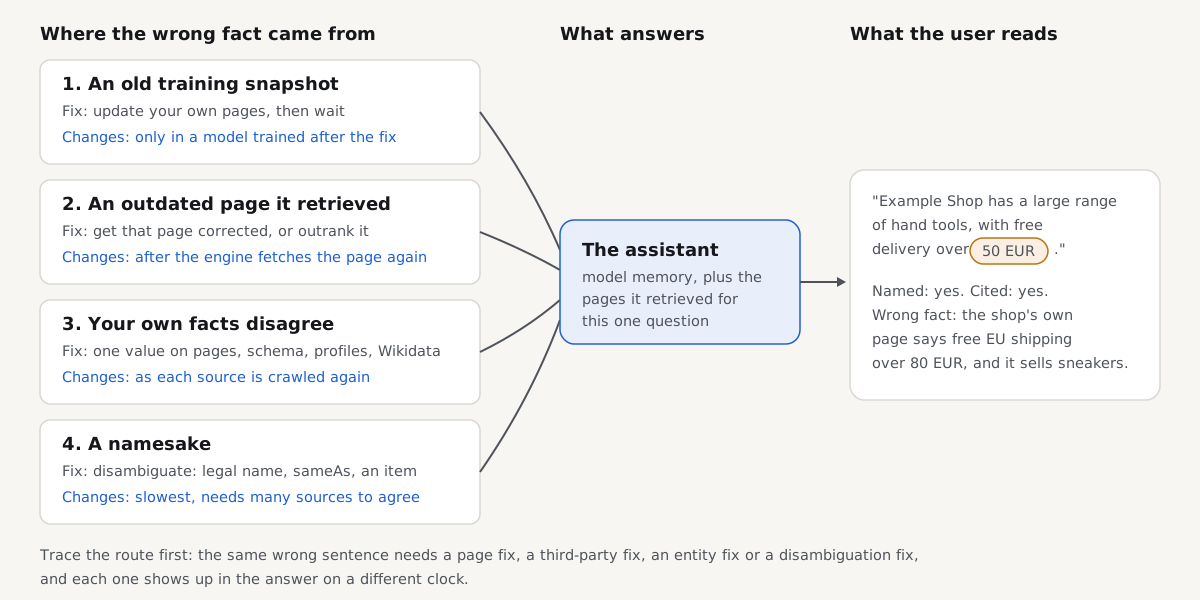
AI brand mentions are the places where an AI assistant names your company in its answer, and the useful question is not only whether it names you but whether what it says is true. A wrong fact almost always traces back to one of four places: an old training snapshot, an outdated retrieved page, your own facts disagreeing, or a company with your name. Google's AI Mode raises the stakes, because it answers whole buying questions in one response; our pillar guide to Google AI Mode covers how it builds those answers. This page is about reading what assistants say about you and correcting it. Getting recommended more often is a different job, covered in how to improve brand visibility in AI search.
Quick answer
- Ask four kinds of question: what is your brand, your brand versus a rival, the best option for a need, and whether you are legit. Each type surfaces a different kind of error.
- Classify every mention: named, recommended, cited with a link, wrong fact, outdated fact, or confused with another brand. Only the last three need fixing.
- Fix your own facts first. One name, one founding year, one address and one phone number on your pages, in your Organization schema and on your profiles. It is the cause you control completely.
- Then fix the pages the answer cites. If the cited source is wrong, the answer will stay wrong until that page changes or a better page replaces it.
- Use Wikidata carefully and Wikipedia almost never. You may correct sourced facts about your organisation on Wikidata; Wikipedia asks people with a conflict of interest to request edits, not make them.
- Report the answer to the operator last. Every assistant has a feedback button, and none promises a correction.
Which questions show what AI says about your brand?
Write down eight to twelve questions in four types, phrased the way a customer would type them:
- Navigational: "What is Example Shop?", "Where is Example Shop based?" These show the facts the assistant holds about you: what you sell, where, since when.
- Comparison: "Example Shop vs Garden Market for delivery to Split?" These show how you are described next to a rival, and they are where outdated prices and policies surface.
- Category: "Best shop for handmade sneakers in Croatia?" These show whether you are named at all when the customer does not know you yet.
- Reputation: "Is Example Shop legit?", "Example Shop reviews?" These show which review pages and forum threads the assistant trusts about you.
Ask each one in each assistant your customers use, in a fresh chat, and save the answer text and its citations. One run is enough to find errors; you are not measuring a trend.
The free tool asks one question for you, as of October 2026 through Claude with live web search, and shows whether the answer names your brand, cites your site and which other sites it relies on. It is one engine and one answer, API answers can differ from the Claude app, ChatGPT and Perplexity are not asked yet, and you get 3 questions a day. It finds the mention; judging whether the mention is true is the rest of this page.
How do you classify a mention?
Give every sentence about you one label. A single answer often earns several.
| Label | What it looks like | Action |
|---|---|---|
| Named | Your brand appears in the text | None; note which question produced it |
| Recommended | You are suggested as an answer to the need | None; note the reason the answer gives |
| Cited with link | Your page is one of the listed sources | Check that the cited page is the right one and is current |
| Wrong fact | A claim about you that was never true | Trace the source, then fix it (playbook below) |
| Outdated fact | A claim that used to be true: an old price, address, founder or product | Find where the old value still lives and update it |
| Confused with another brand | Facts from a namesake merged into yours | Disambiguate your entity (step 2 and 3 below) |
The first three labels are good news and belong to measuring AI visibility. Separate "wrong" from "outdated", because the fix differs: a wrong fact usually comes from a third-party page or a namesake, while an outdated fact is often still sitting somewhere you control, such as an old About page or a plugin's schema settings.
A worked example on our fixture shop
These are recorded fixture examples, not live answers from any engine. The recorded answer in fixtures/examples/ai-brand.json answers "Where can I buy garden tools online in Croatia?", recorded with Claude as the engine on 2026-10-08:
jq '.results[0] | {engine, brandMentioned: .mentions.brandMentioned, domainCited: .mentions.domainCited, citationPosition: .mentions.citationPosition}' fixtures/examples/ai-brand.json{
"engine": "claude",
"brandMentioned": true,
"domainCited": true,
"citationPosition": 2
}By the tool's measure: named, recommended, cited second. Now read the sentence: "Example Shop has the larger range of hand tools, with free delivery over 50 EUR." Our demo shop fixture of example-shop.hr, served locally on port 4101, says something else:
curl -s http://localhost:4101/shipping/ | grep -o 'Free EU shipping over [^,]*' | head -1
curl -s http://localhost:4101/ | grep -o '<title>[^<]*'Free EU shipping over €80
<title>Example Shop | Sneakers made in ZagrebThe two fixtures were built for different demos, so the mismatch is ours, but the exercise holds. The threshold is a wrong fact (50 EUR against 80 EUR), and "hand tools" for a sneaker workshop is either a wrong fact or a confused brand, depending on whether another Example Shop sells garden tools. A mention counter scores this a win; a customer who orders for 60 EUR expecting free delivery does not.
Why do AI answers get facts about your brand wrong?
In the order we expect them, from how assistants build answers:
- An outdated page the engine retrieved. Search-based answers (ChatGPT search, Perplexity, Claude with web search, Google AI Overviews and AI Mode) write from pages fetched for the question. If the top page about your delivery terms is a 2023 directory listing, the answer quotes 2023, and the citations show you which page it was.
- Your own facts disagree. Your About page says founded in 2014, your schema says 2015, an old press page says 2013. The assistant picks one, and you cannot predict which.
- An old training snapshot. An answer that cites nothing likely comes from training. Every model has a published training cutoff, and changes after it are invisible until the model searches.
- A namesake. If another company or product shares your name, facts can merge. It is the hardest to fix and most likely for short, common names.
How to correct what AI says about your brand
Work in this order: the early steps are the ones you fully control.
1. Fix your own pages and structured data
Start where the old or wrong value still lives on your site: About, Contact, footer, shipping and pricing pages, old blog posts that state facts. Then make your Organization (or LocalBusiness, or a subtype such as OnlineStore) JSON-LD say the same thing. Google's Organization structured data documentation describes the properties that matter: name, legalName, alternateName, url, logo, address, telephone, foundingDate and sameAs pointing to your official profiles.
You can read what your schema states in one command. Here it is on our entity fixture of Example Shop, served locally on port 4100:
curl -s http://localhost:4100/entity/ \
  | sed -n '/ld+json/,/<\/script>/p' | sed '1d;$d' \
  | jq '."@graph"[0] | {type: ."@type", name, alternateName, foundingDate, telephone, sameAs}'
curl -s http://localhost:4100/entity/about-us/ | grep -o 'since [0-9]\{4\}'{
"type": "OnlineStore",
"name": "Example Shop d.o.o.",
"alternateName": "Example Shop",
"foundingDate": "2015",
"telephone": "+385 1 234 5678",
"sameAs": [
"https://www.facebook.com/exampleshop",
"https://www.instagram.com/exampleshop"
]
}since 2014The schema says 2015 and the About page says 2014: invisible to a visitor, and exactly what produces a confidently wrong "founded in" line. The fix is one field in whatever writes the JSON-LD, in WordPress usually your SEO plugin's Organization or Knowledge Graph settings. What schema does and does not do for AI answers specifically is in schema markup for AI search.
Google says AI Overviews and AI Mode use its normal search index, so a fixed page counts once Google recrawls it; request that with URL Inspection in Search Console.
2. Make the entity consistent across profiles
Next, the same facts everywhere else you control: Google Business Profile, LinkedIn, Facebook, Instagram, marketplace and directory listings. One name (legal form in legalName), one address format, one phone number in international form, and only your real profiles in sameAs.
The entity consistency checker reads your home page and, when it links them, your About and Contact pages (at most 3 pages), your Organization schema and your Wikidata item, and compares name, founding year, address, phone, logo and profiles. Phone numbers and years must match exactly; addresses are compared after normalising punctuation and the country; names ignore legal forms such as d.o.o. Its recorded example for Example Shop flags the same founding year conflict our curl found:
jq -r '.data.rows[] | [.field, .site, .schema, .status] | @tsv' fixtures/examples/entity-consistency.jsonname Example Shop Example Shop d.o.o. match
founded 2014 2015 mismatch
address Example Shop d.o.o., Ilica 1, 10000 Zagreb, Croatia Ilica 1, 10000 Zagreb, HR match
phone +38512345678 +385 1 234 5678 match
logo https://example-shop.hr/assets/img-160x40.png https://example-shop.hr/assets/img-512x512.png match
profiles 2 linked 2 in sameAs matchThe same findings appear as cards in the full getReport report:
3. Wikidata and Wikipedia: what you may and may not do
Wikidata is a public database that search engines and assistants read for facts about organisations, and the strongest tool against a namesake, because an item with your official website (P856) ties a name to one domain. It is not for everyone. Wikidata's notability policy, as of October 2026, accepts an item that links to a Wikimedia page such as a Wikipedia article, that describes a clearly identifiable entity covered by serious, publicly available sources, or that another item needs structurally. A business known only from its own website usually does not qualify yet, and an item created anyway gets deleted.
If an item exists, you may correct facts about your own organisation: inception (P571), headquarters location (P159), official website (P856), with a reference such as your company register entry. Keep it neutral. We could not find a separate Wikidata conflict of interest guideline as of October 2026, but the Wikimedia Foundation's Terms of Use apply to Wikidata and require anyone paid to edit, an agency for example, to disclose who pays them.
The Wikidata presence checker finds the item for your site by its official website, or by name, and lists what is missing: description, inception, headquarters, official website, identifiers, Wikipedia articles and logo. Our fixture shop has no item, so its recorded example uses a real, well-documented organisation instead (the Wikimedia Foundation, Q180, with a description, a 2003 inception, San Francisco as headquarters and 77 external identifiers). That is what a complete item looks like; the fixture does not show a business item.
Wikipedia is stricter. Its conflict of interest guideline strongly discourages you from editing articles about your own organisation. If an article about you contains an error, disclose your connection on the article's talk page and post an edit request with an independent source. Do not create an article about yourself.
4. Fix the source pages the answer cites
When a wrong answer cites a third-party page, that page is the real target: a directory with your old address, a review site with last year's prices. Contact the owner with the correct fact and a source, or use the platform's "suggest an edit" or owner claim. If the page will not change, publish the correct fact on a page of yours that answers the same question better.
5. Report the answer to the operator
Every operator lets you flag an answer, as of October 2026. None promises to correct a specific fact, so this is the last step.
- Google: Google's help page for AI Overviews describes thumbs-up and thumbs-down controls under each overview and a "Report a problem" route where you pick the category. We could not find a separate help page for AI Mode feedback.
- OpenAI: ChatGPT has thumbs-down feedback on each answer. For inaccurate information about a named person, such as a founder, OpenAI's privacy policy describes a correction request through its privacy request portal, considered under applicable law and what its models can technically do.
- Perplexity: its support FAQ says to use the flag icon below an answer, or to contact support with the URL of the thread and the answer you expected.
- Anthropic: Claude's apps have thumbs-up and thumbs-down on each response. Anthropic's privacy pages say a rating saves the related conversation and may be used to improve its models.
How long does a correction take to show?
| Error type | Likely cause | Fix | When the answer can change |
|---|---|---|---|
| Wrong fact, citation points to a third-party page | That page is wrong | Get the page corrected, or publish a better page | After the engine fetches the page again; no operator publishes a schedule |
| Outdated fact, citation points to your page | An old value still on your site | Update the page and its schema | After the next crawl; for Google, request it in Search Console |
| Two values for one fact across answers | Your pages, schema and profiles disagree | One value everywhere, sameAs to your profiles | As each source is recrawled, one by one |
| Wrong or old fact with no citations | Training data from before the change | Fix the sources above, then wait | Only in a model trained after the fix, or when the assistant searches |
| Facts from another company | A namesake | Wikidata item if notable, legalName, sameAs, distinct descriptions | Slowest: needs many independent sources to agree |
No operator documents these waits in days. The pattern holds: anything retrieved can change on the next fetch, anything trained waits for a new model.
How to verify the fix
Re-run the same questions in a fresh chat and compare the sentence about you with your saved copy. Passing looks like this: the corrected value appears, any citation points to a current page, and the old value is gone from every page you control. In the entity consistency checker, passing means every row reads "match", founded included, and the founding-year card turns green. If the answer still shows the old value but cites nothing, it is the training-data case: your side is done.
How we tested
Written by the getReport team and tested on 2026-10-16. We ran every command above with curl 8.5.0 and jq 1.7 against our own fixtures, served locally: the demo shop fixture of example-shop.hr (port 4101) and its entity fixture (port 4100), plus the recorded tool examples in fixtures/examples/ (ai-brand.json, entity-consistency.json, wikidata-presence.json), which are recordings, not live answers. We read the operator pages under Sources in October 2026.
What we did not test: we asked no live AI engine, submitted no feedback or correction request to any operator, made no Wikidata or Wikipedia edits, and did not measure how long any correction takes to appear. The order of causes is our reading of how retrieval-based answers work, not a measured frequency.
Questions people ask
Why does AI say wrong things about my company?
Usually because the page it read, or the data it was trained on, says the wrong thing. Search-based answers quote the pages they retrieve, so an outdated directory listing or an old About page becomes the answer. Answers without citations often come from training data with a cutoff before your change. Inconsistent facts across your own pages, schema and profiles, or a company with the same name, cause the rest.
Can I ask OpenAI to correct what ChatGPT says about my business?
You can report the answer with the thumbs-down button in ChatGPT, but OpenAI does not promise to correct a specific fact about a business. Its privacy request route covers inaccurate information about a named person, such as a founder. The reliable fix is upstream: correct your own pages and schema, then the third-party pages the answer cites, so the next retrieval reads the right fact.
How long until AI answers show my corrected information?
It depends on where the wrong fact came from. If the answer cites a page, it can change once the engine fetches that page again, which you can speed up for Google with URL Inspection in Search Console. If it cites nothing, it is likely trained knowledge, which changes only with a newer model or when the assistant searches. No operator publishes a timetable.
What if AI confuses my brand with another company of the same name?
Make your entity unambiguous everywhere you control it. Put your legal name in legalName, link only your real profiles in sameAs, use a description that says what you do and where, and keep it identical across profiles. If your organisation meets Wikidata's notability policy, an item with your official website is the strongest single signal that ties your name to your domain.
Should I edit the Wikipedia article about my company?
No, not directly. Wikipedia's conflict of interest guideline strongly discourages editing articles about your own organisation. Disclose your connection on the article's talk page and post an edit request with an independent, reliable source for the correction. Volunteers review it. Paid editors, including agencies, must also disclose who pays them under the Wikimedia Terms of Use.
Does Organization schema stop AI from getting my facts wrong?
No, but it removes one cause. Organization JSON-LD states your name, founding date, address, phone and profiles in a form machines read directly, so a mistake there is one fewer conflicting source. It cannot override an outdated third-party page the answer cites, or a model's training data. Keep the schema identical to your visible pages, because a disagreement between them is itself a source of wrong answers.
Is a brand mention with wrong facts worse than no mention?
Often, yes, when the wrong fact changes a decision. An answer that names you but states the wrong delivery threshold, price or opening hours sends customers in with false expectations, and some will blame you. A missing mention costs a chance; a wrong one can cost a sale and a review. That is why classifying what the answer says matters more than counting how often it names you.
Sources
- Google Search Central: AI features and your website (accessed October 2026)
- Google Search Central: Organization structured data (accessed October 2026)
- Google Search Help: AI Overviews in Google Search (accessed October 2026)
- OpenAI: Privacy policy (accessed October 2026)
- Perplexity Help Center: Need support? (accessed October 2026)
- Anthropic Privacy Center: Is my data used for training? (accessed October 2026)
- Wikidata: Notability (accessed October 2026)
- Wikipedia: Conflict of interest (accessed October 2026)