AI visibility is how often AI assistants (ChatGPT, Perplexity, Claude, Microsoft Copilot and Google's AI Overviews and AI Mode) read your pages, cite them in answers and send you visitors. The term gets used loosely, so this guide pins it down and then shows you how to measure each part with data you already have: your analytics, your server log, and the AI reports Google and Bing added in 2026. It is one chapter of our pillar guide to generative engine optimization, which covers the whole topic of being read and cited by AI search. Here you will learn what AI visibility actually consists of, which numbers are real, and where every tool (including ours) hits a wall.
Quick answer
- AI visibility has three layers: AI crawlers can read your pages (access), AI answers cite or name your site (presence), and people arrive from AI assistants (traffic). Measure each separately.
- Traffic is the easiest. Filter referrals from chatgpt.com, perplexity.ai, claude.ai and copilot.microsoft.com in your analytics; ChatGPT adds
utm_source=chatgpt.comto its links. - Access shows in your server log: requests from GPTBot, OAI-SearchBot, ClaudeBot, PerplexityBot and friends. Analytics never shows them, because bots do not run your tracking script.
- Citations are only partly measurable. Search Console reports impressions in Google's AI features and Bing Webmaster Tools counts Copilot citations, but OpenAI, Anthropic and Perplexity offer no equivalent.
- Spot checks fill the gap: ask the assistants your buyers' questions and note who gets cited. Treat the results as a trend, not a ranking.
- Check the access layer in a minute with the free AI crawler check.
What is AI visibility?
When people say a site "is visible in AI", they can mean three different things. Keeping them apart matters, because each is measured with a different source and improved with different work.
- Access: AI systems can read you. The crawlers that feed AI products (OpenAI's, Anthropic's, Perplexity's, Google's) can fetch your pages, and the text is readable in the HTML they receive. Access is a precondition, not visibility itself, but it is the only layer you fully control and can measure exactly.
- Presence: AI answers use you. An assistant cites your page as a source, links it, or names your brand in its answer. This is what most people picture, and it is the hardest layer to measure.
- Traffic: AI sends you people. Someone clicks a citation or a link in an answer and lands on your site. This shows up in your analytics like any other referral.
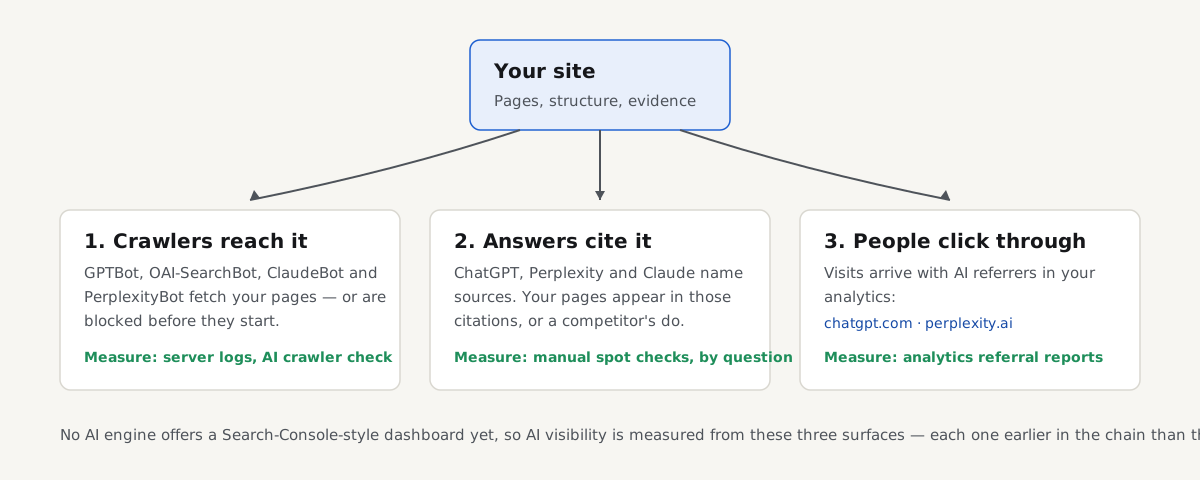
A site can have full access and zero presence, and a famous brand can be named in answers that never link it. So one "AI visibility score" is always a simplification; when a tool or an agency quotes you one, ask which of the three layers it counts.
Is AI visibility different from search visibility?
Partly. Classic search visibility is a position in a list of links, measured in rankings, impressions and clicks. AI search visibility is a place inside a written answer, measured in citations, mentions and referrals, and an answer has three to ten sources where a results page has a ranked list. The foundations overlap almost completely: most AI products retrieve pages through a search index, and Google says optimising for its AI features is still SEO.
Two differences matter for measurement. First, there is no position: the same question can produce different sources on the next run, and assistants personalise answers with memory and location, so nothing is as stable as a ranking. Second, the reporting is thinner: search engines spent 20 years building consoles and APIs, while most AI operators report nothing at all. What you can measure, in order of reliability, is below.
How to measure AI visibility
Four sources, from the one you control to the one you can only sample. Together they cover all three layers.
1. AI referral traffic in your analytics
The traffic layer is ordinary referral data. Visits from AI assistants carry the referrer of the product's domain: chatgpt.com, perplexity.ai, claude.ai, copilot.microsoft.com, gemini.google.com. ChatGPT also appends utm_source=chatgpt.com to the links it shows, which OpenAI documents in its publisher FAQ, so those visits are easy to isolate even when the referrer is stripped. Build one segment or channel group for all of them and watch its trend and its landing pages.
Expect the number to be a floor, not a total. Some apps and in-app browsers send no referrer, so part of your AI traffic lands in "direct", and clicks from Google's AI Overviews carry a normal google.com referrer, indistinguishable from classic search clicks. AI referrals also stay small on most sites (if they are 1% of your sessions, that is normal in 2026) so judge pages by what the visits do, not only how many there are.
2. AI crawlers in your server log
The access layer never appears in Google Analytics, because crawlers do not run JavaScript trackers. It appears in your server's access log, where each AI fetch identifies itself by user agent. The names to look for come in three groups:
| Purpose | User agents | What a hit means |
|---|---|---|
| Model training | GPTBot, ClaudeBot | Your content may end up in training data |
| AI search index | OAI-SearchBot, Claude-SearchBot, PerplexityBot | The product can retrieve and cite you |
| Fetch for a user | ChatGPT-User, Claude-User, Perplexity-User | A person asked something that led to your page, right then |
The third group is the quiet gem: user-triggered fetchers only visit because of a live question, so rising ChatGPT-User hits on a page are demand you can see nowhere else. Detecting AI crawlers in your server logs shows where the log lives, how to count each bot and how to spot fakes that borrow the names.
3. The operator reports: Google and Bing
In 2026 the presence layer finally got official numbers: from two operators.
Google. The standard Search Console Performance report folds AI Overviews and AI Mode activity into the "Web" search type: Google Search Central documents that AI-feature impressions and clicks are counted in the overall totals, with no way to split them out there. Since 2026 there is also a dedicated Generative AI performance report, announced in June and rolled out to all sites worldwide by 31 August 2026. It shows impressions of your links in AI Overviews, AI Mode and AI features in Discover by page, country, device and date, but no clicks and no questions, and since 7 September 2026 AI Overviews and AI Mode impressions are combined into one number.
Microsoft. Bing Webmaster Tools added an AI Performance report, still labelled a preview, that goes further: it counts citations (how many times Copilot and Bing's AI answers used each of your pages as a source) and lists the "grounding queries" the AI generated to find them. Those queries are not what users typed, but they tell you which topics you are cited for. If your site is not verified in Bing Webmaster Tools, this report is the reason to spend the 10 minutes.
Everyone else: nothing. OpenAI, Anthropic and Perplexity offer no Search Console equivalent; no report of how often ChatGPT, Claude or Perplexity cite or mention you. For those products you are limited to referrals, user-triggered fetches in the log, and spot checks.
4. Manual spot checks and prompt tracking
The last source samples what the reports cannot show: what the answers actually say. Write down 10-20 questions your buyers really ask, phrased the way they would ask them. Once a month, run each through ChatGPT search, Perplexity and Copilot, and record two things per answer: is your site cited, and is your brand named. An hour of work gives you a baseline you can compare over time.
Prompt-tracking tools automate the same idea at a larger scale, and their limits are the same as yours. Answers change between runs, accounts, locations and model versions, so a single result means little and a "position" in an answer does not exist. Whether you track by hand or pay a tool, compare month to month and read trends, not single answers.
How to check the access layer
The check reads what your site tells AI systems: your robots.txt verdict for 18 AI crawlers from OpenAI, Anthropic, Google, Perplexity and others, grouped by purpose; whether your llms.txt is valid; whether the page carries noai or TDM opt-out tags; and how much of your text only exists after JavaScript runs, which most AI crawlers never do. It checks access and readability; it does not track rankings, count citations or tell you what ChatGPT says about you, because no crawl of your own site can. The same findings appear in every getReport report:
A blocked search bot or a page that is empty without JavaScript caps every other layer at zero, which is why access is the first thing to measure, not the last.
What no tool can see
Knowing the blind spots keeps you from paying for numbers nobody has:
- Mentions without links are invisible to analytics, logs and both operator reports. Only spot checks and prompt trackers sample them.
- There is no citation count for ChatGPT, Claude or Perplexity. Any tool claiming an exact one is extrapolating from samples.
- Training data cannot be inspected. What a model learned about your brand months ago shows up in answers but in no report, and you cannot edit it.
- Google's AI clicks hide in the totals. A visitor from an AI Overview looks like any other Google click, so you cannot credit revenue to the AI surface.
Measurement tells you where you stand; it does not move the needle by itself. When your baseline shows gaps, the work of closing them (allowing the right crawlers, serving text without JavaScript, writing pages worth quoting) is covered in our guide to improving your AI search visibility, and the ChatGPT-specific steps are in how to rank in ChatGPT.
Questions people ask
What is AI visibility?
AI visibility is how often AI assistants such as ChatGPT, Perplexity, Claude, Copilot and Google's AI Overviews read your site, cite or name it in their answers, and send you visitors. It has three measurable layers: crawler access, presence in answers, and referral traffic. A single score always compresses those three, so ask which layer any number you are shown actually counts.
How do I measure AI visibility?
Combine four sources. Filter AI referrers such as chatgpt.com and perplexity.ai in your analytics; count AI crawler requests in your server log; read the Generative AI report in Search Console and the AI Performance report in Bing Webmaster Tools; and spot-check 10-20 real buyer questions in the assistants monthly. Each covers a layer the others miss, and the whole setup costs nothing.
Is AI visibility different from SEO?
The foundations are the same (Google says optimising for its AI features is still SEO) but the measurement differs. There are no stable positions, because answers change between runs and users; success is citations, mentions and referrals instead of rankings; and only Google and Microsoft offer official reports. The extra technical work is small: crawler access and text that is readable without JavaScript.
Which AI assistants send referral traffic?
ChatGPT, Perplexity, Claude, Copilot and Gemini all send visits with their own referrers: chatgpt.com, perplexity.ai, claude.ai, copilot.microsoft.com and gemini.google.com. ChatGPT also tags its links with utm_source=chatgpt.com. Clicks from Google's AI Overviews are the exception: they arrive with a normal google.com referrer, so you cannot separate them from classic search clicks.
Can I see my site's citations in ChatGPT?
Not from OpenAI: there is no publisher report of citations or mentions for ChatGPT. You can see the indirect evidence (visits tagged utm_source=chatgpt.com in analytics and ChatGPT-User fetches in your server log) and you can sample answers yourself by asking ChatGPT your buyers' questions. Bing Webmaster Tools counts citations, but only for Microsoft's Copilot, not for ChatGPT.
Is there a Search Console for ChatGPT or Perplexity?
No. As of September 2026, neither OpenAI, Anthropic nor Perplexity offers a webmaster console, a citation report or an API for publishers. The only official AI reports come from Google, whose Search Console shows impressions in AI Overviews and AI Mode, and from Microsoft, whose Bing Webmaster Tools counts Copilot citations. For every other product, referrals, server logs and spot checks are the whole toolkit.