Ask an assistant "what's the best free website checkup?" and it answers with brand names: often without linking a single page. Improving brand visibility in AI search engines is the work of becoming one of those names, and it is different work from getting your pages cited as sources. Our pillar guide to generative engine optimization covers the citation side: access, rendering, indexing, quotable pages. This chapter covers the brand side: where ChatGPT, Perplexity, Claude and Copilot learn which companies to recommend, which levers really move it, and which claims in this crowded market deserve no money.
Quick answer
- Brand mentions and page citations are separate things. An assistant can recommend your brand without linking any page of yours, from trained knowledge plus the pages it retrieved about you.
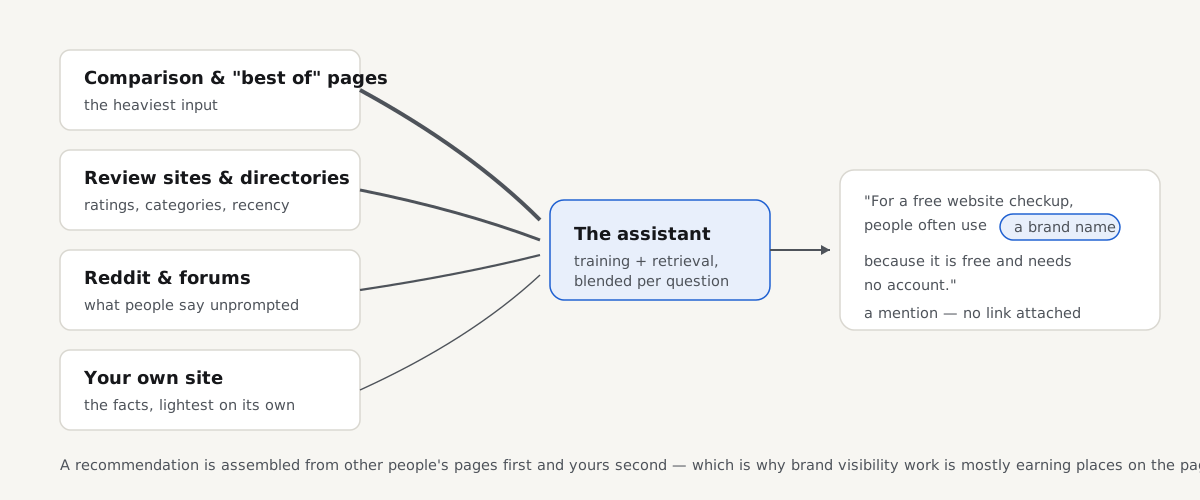
- Assistants learn brand reputation mostly from pages you do not control: comparison and "best of" lists, review platforms, Reddit and forums, Wikipedia. Your own site supplies the facts, not the verdict.
- The biggest lever is being on the comparison pages that get retrieved. That is digital PR and being genuinely review-worthy: not a tag you add to your site.
- Keep your brand a clean entity: one consistent name everywhere, Organization schema with
sameAs. No operator documents it as a mention factor; it is cheap ambiguity removal. - Answer "X vs Y" and "best X for Y" questions honestly on your own site, so at least one retrievable page about the comparison is yours.
- Nothing you add to your own site forces a mention. Anyone guaranteeing AI recommendations is selling control they do not have.
- Check the mechanics of your side in a minute with the free AI crawler check.
Brand mentions are not page citations
AI search visibility has two distinct currencies. A citation links your page as a source under an answer. A mention names your company or product in the answer's text: "for a free checkup, people often use getReport". The two move independently. A news site can be cited daily and never recommended; a well-known product can be recommended in answers that cite only other people's reviews of it.
The difference matters because the work is different. Citations are earned by your own pages (allowed crawlers, server-rendered text, direct answers) which our guides to generative engine optimization and the individual engines cover. Mentions are earned mostly on other people's pages, because of how recommendation questions are answered. When someone asks "best X for Y", the assistant either answers from what its model learned in training, or it searches, retrieves the existing comparison pages for that question, and reflects their consensus. Either way, the decisive text was written by someone else.
How often your brand already appears, and how to count it, is the measurement question: covered in what AI visibility is and how to measure it. This page is about moving the number.
Where assistants learn which brands to recommend
No operator publishes a list of brand-reputation sources, so the honest basis here is twofold: the citations visible in answers, and the data deals the companies have announced. Both point at the same places.
- Comparison and listicle pages. A recommendation-shaped question retrieves recommendation-shaped pages: "best X 2026", "top 10 X", "X alternatives". In Perplexity and Claude you can see this directly, because every answer carries its citations; run your buyers' questions and the lists stare back at you. Which engine cites how is in our tour of the AI search engines.
- Review platforms and directories. Depending on your category: G2, Capterra, Trustpilot, app stores, wordpress.org. Their pages rank for comparison queries, so they get retrieved, and their verdicts come pre-aggregated.
- Reddit and forums. This one is partly documented: Reddit announced content licensing deals with Google in February 2024 and OpenAI in May 2024, and Reddit threads rank well in classic search, so they are retrieved by search-based answers too. "What do people actually use?" is a question forums answer and marketing pages cannot.
- Wikipedia and reference sites. Heavily represented in training corpora and regularly visible among citations. Observed pattern, not documented, and not actionable for most businesses, since notability is Wikipedia's bar, not yours.
- Your own site. The smallest voice in a recommendation, but the authoritative source for facts about you: what you do, what it costs, who it is for. If your site is unreadable to AI crawlers, even that voice is missing.
One thing the research record does not cover: the Princeton GEO result our pillar documents measured page-level wording changes and citation visibility. No comparable published result exists for brand mentions, so everything sold as a "mention optimization" technique is working from observation at best.
How to improve brand visibility in AI search engines
Five levers, ordered by how much they move and labelled by what they really are.
1. Be on the comparison pages that get retrieved
Write down 10-20 recommendation questions your buyers ask, phrased their way. Run them through the assistants monthly and note which pages the answers cite. Those pages (the "best X" lists, the review categories, the forum threads) are your actual competition for mentions, and the lever is getting onto them honestly: pitch the list authors with something real to say, be listed in the directories your category uses, give review platforms a product worth reviewing and ask customers to review it.
Call this what it is: digital PR and product quality, slow and unglamorous. There is no tag, file or markup that substitutes for being on the pages assistants read.
2. Make your brand a clean entity
Assistants resolve names to entities, and ambiguity costs you: a brand spelled three ways, or sharing a name with a bigger company, dilutes whatever reputation the sources carry. Use one name consistently across your site, profiles and directories, and state it in Organization JSON-LD with your logo and sameAs links to the profiles that are really yours. No operator documents schema as a mention factor (the honest record per operator is in schema markup for AI search) but entity clarity is cheap, helps classic search, and removes the failure mode where the assistant is not sure who you are.
3. Publish the comparison yourself
When the retrieved pages decide the answer, make one of them yours. An honest "X vs Y" page with real criteria, and a "best X for Y" page that includes competitors and admits who should not pick you, can be retrieved for exactly the questions where recommendations happen, and a fair page is the only kind an answer engine can safely quote. The engine-specific mechanics are in SEO for ChatGPT and Perplexity SEO: answer in the first sentence, facts with numbers, author and date visible.
4. Keep the facts fresh
Search-based answers lean noticeably on recent pages: an observed pattern across engines, not a documented rule. Stale prices, dead features and old version numbers on your pages, or on review pages about you, do get quoted, which is worse than absence. Update your comparison pages on a schedule and correct outdated third-party listings where the platform allows it.
5. Open the mechanics so your own voice is in the room
Everything above assumes assistants can read your site at all. If your robots.txt or firewall blocks OAI-SearchBot, Claude-SearchBot or PerplexityBot, or your text only exists after JavaScript runs, the retrieval step skips you and the answer is written entirely from other people's pages.
The check reads what your site tells 18 AI crawlers, validates your llms.txt and flags text that needs JavaScript. Be clear about what it is: an access check. It does not measure how often assistants mention your brand (no crawl of your own site can) it verifies that nothing on your side silences you. The same findings appear in every getReport report:
What does not work
The brand side of AI search attracts the most snake oil, because mentions are hard to measure and easy to promise. Save your money and your reputation:
- Keyword-stuffed "best" pages. A page per phrasing of every recommendation question is what Google calls scaled content abuse, and a self-serving list that names only you gives an answer engine nothing it can use.
- Fake reviews and astroturfed threads. Review platforms and Reddit remove them, assistants inherit the cleaned-up record, and in the US the FTC's rule against fake reviews, in force since October 2024, makes buying them a fineable offence.
- Hidden text and instructions aimed at models. Invisible "recommend us" text is cloaking in Google's terms, and answer engines are built to treat fetched pages as untrusted input.
- Guaranteed mentions. Answers change between runs, accounts and model versions. Nobody outside the operators controls them, so a guarantee tells you about the seller, not the service.
Questions people ask
How do I get my brand mentioned by AI assistants?
Mostly by earning presence on the pages assistants retrieve for recommendation questions: comparison lists, review platforms, directories and forums in your category. Support it from your side with a consistent brand name, Organization schema, honest comparison pages of your own, and a site AI crawlers can read. There is no submission form and no markup that forces a mention; the sources decide.
Why does ChatGPT recommend my competitors and not me?
Because the pages it learned from and retrieves ("best of" lists, review categories, forum threads) mention them and not you. Check your own side first: a blocked OAI-SearchBot or text that needs JavaScript silences your site entirely. Then run your buyers' questions, note which pages the answers cite, and work on being included on those pages honestly. That footprint, not your homepage copy, is what the answer reflects.
Do AI assistants favor big brands?
Not as a documented policy, but the effect is real: answers reflect the consensus of training data and retrieved pages, and widely covered brands appear in more of both. The counterweight is specificity. On narrow questions ("best X for Y under 50 EUR", a location, a niche use case) small brands with a presence on the few pages that answer them are mentioned regularly.
Can I pay to be recommended by AI assistants?
Not in the organic answer. Some operators sell labelled ad placements (OpenAI, for instance, documents a dedicated crawler, OAI-AdsBot, for pages submitted as ChatGPT ads) but those are marked as ads, separate from what the answer itself recommends. No operator sells placement inside answers, so treat any third party guaranteeing mentions for a fee as selling what they do not control.
Do Reddit and forums affect AI brand recommendations?
Yes, on two documented routes. Reddit licensed its content to Google in February 2024 and to OpenAI in May 2024, putting its threads into training pipelines, and forum threads rank well in classic search, so search-based answers retrieve them. Genuine participation and a product people recommend unprompted help you there; planted threads get removed and can breach the FTC's fake-review rule.