On shared hosting, .htaccess is often the only configuration you can touch, and it can do more than most people use it for: one clean redirect to your final address, a full set of security headers, compression, cache lifetimes and a lock on the files bots look for first. This guide builds the file section by section, says where each part goes relative to WordPress's own block, and ends with the checks that prove it works. Every snippet here was run on Apache 2.4. Allow 45 minutes, and keep a copy of the current file before you start.
Quick answer
- One
RewriteRulesends everyhttp://andwwwrequest tohttps://example.comin a single 301. Header always setfor HSTS, CSP (report-only first),X-Content-Type-Options,X-Frame-Options,Referrer-PolicyandPermissions-Policy.alwayscovers error pages and redirects too.AddOutputFilterByTypewithBROTLI_COMPRESSandDEFLATEfor text types only.mod_expiresfor lifetimes by type, plusimmutableon hashed file names.ErrorDocument 404,Options -Indexes, and deny rules for dotfiles and backups.- Everything goes above
# BEGIN WordPress. A typo returns 500 for the whole site, so test on a copy first, then run the security headers checker.
Why .htaccess matters on shared hosting
Apache reads .htaccess on every request, from the folder being served and each parent, so a change is live the moment you save. That is what makes it the tool of choice on hosts where you cannot edit the server configuration or restart anything. The modules that matter here, mod_rewrite, mod_headers, mod_deflate and mod_expires, are enabled on almost every shared host; mod_brotli is on many.
Some things are out of reach. TLS protocol versions, ciphers and HTTP/2 are set in the server configuration, which belongs to the host. If the report says the server still accepts TLS 1.0, or that the page loads over HTTP/1.1, no line in .htaccess changes that; ask the host, or put a CDN in front. The same goes for the Server header's version number: ServerTokens Prod only works in the main configuration.
The rest is yours, and it adds up. A typical untouched shared-hosting site loses points for a two- or three-hop redirect chain, five missing headers, uncompressed CSS and JavaScript, and images without a cache lifetime. All of that is fixed by about 60 lines in one file.
How getReport checks it
The headers checker grades the final response after redirects, so a header set in .htaccess counts exactly like one set by the host. The redirect checker follows the URL you enter hop by hop, and also requests the http:// version and the other www variant to see whether they reach your final host. The report counts the hops from the URL you typed: one redirect passes, two or more is a warning.
Compression and caching come from a full page load in Chromium: every text response is checked for a Content-Encoding, and every script, stylesheet, image and font for a positive max-age, immutable or a future Expires date. The .env and .git/HEAD paths are requested directly, and so are up to three asset folders the page uses, to catch an "Index of /" listing.
Step by step
The file is .htaccess in the site's document root (often public_html/). Replace example.com with your final host. Each block below goes in the order shown.
1. One redirect to the final address
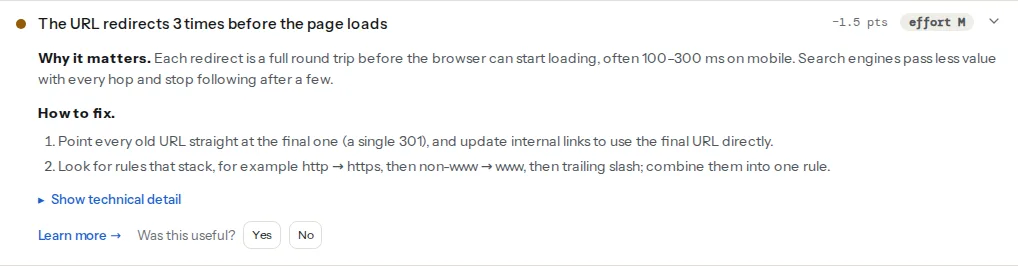
The chain in the screenshot usually comes from two or three separate rules (redirects explains what each hop costs): one for HTTPS, one for www, one for the slash. Each fires, redirects, and the next request hits the next rule. The fix is one rule with two conditions:
<IfModule mod_rewrite.c>
RewriteEngine On
RewriteCond %{HTTPS} off [OR]
RewriteCond %{HTTP_HOST} !^example\.com$ [NC]
RewriteRule ^ https://example.com%{REQUEST_URI} [L,R=301]
</IfModule>
In words: if the request is not HTTPS, or the host is anything other than example.com, send it to https://example.com with the same path. The query string is kept automatically. http://www.example.com/page?x=1 now arrives at https://example.com/page?x=1 in one hop. If you prefer www as the final host, write www.example.com in both places.
Behind Cloudflare, a load balancer or a host's proxy, Apache may see every request as plain HTTP even when the visitor used HTTPS, which turns this rule into an endless loop. In that case, test the header the proxy sets instead:
RewriteCond %{HTTP:X-Forwarded-Proto} !https [OR]
RewriteCond %{HTTP_HOST} !^example\.com$ [NC]
RewriteRule ^ https://example.com%{REQUEST_URI} [L,R=301]
On WordPress, leave trailing slashes to WordPress: the permalink structure decides, and WordPress redirects the other form itself. On a static site with folder-style URLs, Apache adds the slash to directories on its own (DirectorySlash), so no rule is needed. Trailing slashes, www and HTTPS covers the choice.
2. Security headers
<IfModule mod_headers.c>
Header always set Strict-Transport-Security "max-age=31536000; includeSubDomains"
Header always set Content-Security-Policy-Report-Only "default-src 'self'; script-src 'self'; style-src 'self' 'unsafe-inline'; img-src 'self' data: https:; font-src 'self'; connect-src 'self'; frame-ancestors 'self'; base-uri 'self'; form-action 'self'; object-src 'none'"
Header always set X-Content-Type-Options "nosniff"
Header always set X-Frame-Options "SAMEORIGIN"
Header always set Referrer-Policy "strict-origin-when-cross-origin"
Header always set Permissions-Policy "camera=(), microphone=(), geolocation=(), payment=()"
Header always unset X-Powered-By
Header unset X-Powered-By
</IfModule>
Header set without always only applies to successful responses. A 404 page, a 500 error or the redirect from step 1 then goes out without HSTS or framing protection. With always, every response carries them.
SAMEORIGIN rather than DENY because WordPress's customizer previews the site in a frame on the same domain. The CSP starts in report-only mode, which the check counts as present, so you can watch the browser console for a week before switching the header name to Content-Security-Policy. Security headers from zero to A explains each header.
X-Powered-By: PHP/8.1.2 is added by PHP, and depending on how the host runs PHP it lands in either of Apache's two header tables, so the file removes it from both. The clean fix is expose_php = Off, which only works in php.ini or the host's PHP settings panel, not in .htaccess.
3. Compression
<IfModule mod_brotli.c>
AddOutputFilterByType BROTLI_COMPRESS text/html text/css text/plain text/xml text/javascript application/javascript application/json application/xml application/rss+xml application/manifest+json image/svg+xml
</IfModule>
<IfModule mod_deflate.c>
AddOutputFilterByType DEFLATE text/html text/css text/plain text/xml text/javascript application/javascript application/json application/xml application/rss+xml application/manifest+json image/svg+xml
</IfModule>
A browser that asks for Brotli gets Brotli, one that only asks for gzip gets gzip, and nothing is compressed twice. List both JavaScript types: newer servers send .js as text/javascript, older ones as application/javascript, and a type missing from the list goes out uncompressed. Leave images, fonts, video and archives out; they are compressed already.
4. Cache lifetimes
<IfModule mod_expires.c>
ExpiresActive On
ExpiresDefault "access plus 0 seconds"
ExpiresByType text/html "access plus 0 seconds"
ExpiresByType text/css "access plus 1 year"
ExpiresByType text/javascript "access plus 1 year"
ExpiresByType application/javascript "access plus 1 year"
ExpiresByType font/woff2 "access plus 1 year"
ExpiresByType image/avif "access plus 1 week"
ExpiresByType image/webp "access plus 1 week"
ExpiresByType image/jpeg "access plus 1 week"
ExpiresByType image/png "access plus 1 week"
ExpiresByType image/svg+xml "access plus 1 week"
ExpiresByType image/x-icon "access plus 1 week"
</IfModule>
<IfModule mod_headers.c>
<FilesMatch "\.[0-9a-f]{8,}\.(css|js|woff2)$">
Header set Cache-Control "public, max-age=31536000, immutable"
</FilesMatch>
</IfModule>
mod_expires writes both an Expires date and the matching Cache-Control: max-age, so older and newer caches agree. A year for CSS and JavaScript is safe when their URLs change on every edit, which WordPress does with ?ver= and build tools do with a hash in the file name. If yours do neither, use a week. The FilesMatch block adds immutable to hashed names like app.3f9a1c2b.js, so browsers do not even revalidate them. HTML gets max-age=0: stored, but checked on every visit.
5. The 404 page and the files nobody should see
ErrorDocument 404 /404.html
Options -Indexes
RedirectMatch 404 /\.(?!well-known/)
<FilesMatch "(^wp-config\.php|\.(bak|old|orig|sql|log|swp)|~)$">
Require all denied
</FilesMatch>
<Files xmlrpc.php>
Require all denied
</Files>
ErrorDocument must be a path on your own site. A full URL (https://example.com/404.html) makes Apache send a redirect instead of a 404, and the report's custom-404 check, which requests a random path without following redirects, fails. WordPress renders its own 404 through index.php; the line matters for static sites and folders outside WordPress.
Options -Indexes stops Apache from listing a folder's contents when it has no index file. RedirectMatch 404 answers every path that starts with a dot, .env, .git/, .htpasswd, with a plain 404, while leaving /.well-known/ reachable for certificate renewals and security.txt. The FilesMatch block refuses wp-config.php and the backup and dump files that editors and migration tools leave behind; WordPress still reads wp-config.php from disk, it just cannot be downloaded. The xmlrpc.php block is for WordPress sites that do not use Jetpack or the mobile apps, which need it.
6. Where WordPress's block goes
WordPress writes its own section between # BEGIN WordPress and # END WordPress and rewrites it whenever permalinks are saved. Anything you put inside is lost. Anything you put below it runs too late: the block's last rule sends every request that is not a real file to index.php, and a redirect placed after it would redirect index.php itself. So the order is: your blocks 1 to 5, then the WordPress block, unchanged:
# BEGIN WordPress
# The directives (lines) between "BEGIN WordPress" and "END WordPress" are
# dynamically generated, and should only be modified via WordPress filters.
# Any changes to the directives between these markers will be overwritten.
<IfModule mod_rewrite.c>
RewriteEngine On
RewriteRule .* - [E=HTTP_AUTHORIZATION:%{HTTP:Authorization}]
RewriteBase /
RewriteRule ^index\.php$ - [L]
RewriteCond %{REQUEST_FILENAME} !-f
RewriteCond %{REQUEST_FILENAME} !-d
RewriteRule . /index.php [L]
</IfModule>
# END WordPress
Caching and security plugins add blocks of their own at the top (# BEGIN LSCACHE, # BEGIN WP Rocket). Leave those where they are, and remove any of their options that duplicate your headers or compression.
7. Test before you trust it
A syntax error in .htaccess does not break one page; it returns "500 Internal Server Error" for every request. Options needs the host to allow it (AllowOverride Options); if it is not allowed, the result is the same 500. So:
- Download the current file and keep it as
htaccess-backup.txt. - Upload the new version to a staging copy if you have one, or during a quiet hour if you do not.
- Check from a terminal:
curl -sI http://www.example.com/ | grep -i -E "^HTTP|location"
curl -sI https://example.com/ | grep -i -E "strict|content-security|x-content|x-frame|referrer|permissions|x-powered"
# any stylesheet from your page source; this one exists on every WordPress site
curl -sI -H "Accept-Encoding: br, gzip" https://example.com/wp-includes/css/dist/block-library/style.min.css | grep -i -E "content-encoding|cache-control"
curl -s -o /dev/null -w "%{http_code}\n" https://example.com/.env
The first should show one 301 to https://example.com/; the second all six headers and no x-powered-by; the third br or gzip and a max-age; the fourth 404. If anything returns 500, put the backup back and check the host's error log for the line number.
Platform notes
WordPress
Blocks 1 to 5 go above # BEGIN WordPress. If a security plugin already sets headers, keep one source: two X-Frame-Options values confuse browsers.
LiteSpeed hosts
LiteSpeed Web Server reads .htaccess and understands the rewrite, header and expires directives above, so the same file works. Compression is configured in LiteSpeed itself; check the compression finding rather than relying on the mod_deflate block. Its cache plugin writes a block at the top; keep it there.
Nginx hosts
If the Server header says nginx, .htaccess is ignored completely; nothing in it has any effect. Ask the host where headers and redirects are configured, or see Nginx configuration for an A grade.
Verify
- Redirect checker on all four variants:
http://example.com,http://www.example.com,https://www.example.comandhttps://example.com. The first three end onhttps://example.com/in one hop; the last has none. - Security headers checker: every header finding passes,
X-Powered-Byis gone. TheServerversion is the host's to hide. - HTTP/2 test: the compression and cache findings pass; the protocol rows show what the host provides.
- Full report: the exposed-files and directory-listing findings pass, and a random missing URL gets your 404 page.
Common mistakes
- Two redirect rules that chain. Symptom: the redirect checker shows
http://www→https://www→https://. Fix: one rule with both conditions, as in step 1, and remove the old ones, including a plugin's "force HTTPS" option. Header setwithoutalways. Symptom: headers present on pages but missing on redirects and error pages. Fix:Header always set.- Rules below the WordPress block. Symptom: redirects never fire, or visitors land on
/index.php. Fix: move them above# BEGIN WordPress. - Overwriting
mod_expireswith a bareCache-Control. Symptom:Cache-Control: publicwith nomax-age, and the cache finding lists the files. Fix: letmod_expiresset the lifetime, or write the full value withmax-age. - Compressing images. Symptom: slower responses, no smaller files. Fix: text types only in
AddOutputFilterByType.