# Faceted navigation and parameter URLs: keeping filters out of the index
> Filters and sort options turn one category into thousands of URLs. Learn which parameter URLs to index, which to canonicalise, noindex or block in robots.txt, and how to see what Googlebot actually crawls on your shop.
Updated 2026-09-25 · Technical SEO · HTML version: https://getreport.app/guides/faceted-navigation-and-parameter-urls
A category page with filters for colour, size, price and a sort order is one page to a visitor and thousands of URLs to a crawler: every combination of every value is a new address. Left alone, Googlebot spends its visits on `?colour=red&size=42&sort=price` variants while new products wait, and the index fills with near-duplicates that compete with the category itself. This guide gives a decision per parameter type, the three controls and what each one does and does not do, the platform specifics for WooCommerce, Shopify and Magento, and the way to see what Googlebot really crawls. Plan half a day for the decisions, and a deploy for the fixes.
## Quick answer
| Parameter type | Example | What to do |
| --- | --- | --- |
| Sort, view, items per page | `?sort=price`, `?view=grid`, `?per_page=48` | Canonical to the base URL; optionally block in robots.txt |
| Pagination | `?page=3` | Keep crawlable and self-canonical; do not canonical to page 1 |
| Single filter with search demand | `/shoes/red/` or `?colour=red` | Make it a real landing page: unique title, H1, text, self-canonical, in the sitemap |
| Multi-select combinations | `?colour=red&size=42&brand=x` | `noindex`, or canonical to the single-facet page; block crawling once the good pages are indexed |
| Tracking and session parameters | `?utm_source=`, `?sessionid=` | Canonical to the clean URL; strip them at the server or CDN where possible |
Rules that hold everywhere: one parameter order, one value spelling, `rel="canonical"` on every variant, and never both `noindex` and a robots.txt block on the same URL, because a blocked page cannot be read and so cannot be de-indexed.
## Why parameter URLs matter
Three things go wrong, in order of how fast they hurt.
**Crawl waste.** Google allocates a crawl rate to a site based on how fast it answers and how useful its pages have been. A shop with 200 categories, five facets of ten values each and four sort orders has, in theory, tens of millions of URLs. Googlebot does not crawl them all, but it does crawl a lot of them, and the log analyser shows the result on real shops: half of Googlebot's visits on parameter URLs, while new products and updated prices wait days for a fetch.
**Duplicate content.** `/shoes/?sort=price` shows the same products as `/shoes/`, in a different order. Google is good at picking one, but the pick is not always yours, and each duplicate splits the links and signals that should go to the category. On a large site the "Duplicate without user-selected canonical" row in Search Console is where the category's authority went.
**Index bloat.** Thousands of thin filter pages in the index dilute the site's overall quality signal and produce results nobody wants: a visitor searching for red shoes lands on `?colour=red&size=36&sort=newest` with two products. Google's own [guidance on faceted navigation](https://developers.google.com/search/docs/crawling-indexing/crawling-managing-faceted-navigation) is direct about it: decide which facets deserve to be indexed and keep the rest from being crawled at all.
The opposite mistake exists too. Some facets are queries people type: "red running shoes", "size 46 boots", "waterproof jackets under 100". A single-facet page with real content is a landing page for a query the category alone cannot answer. Blocking every filter throws those away.
## How getReport checks it
> **Free tool:** [Free SEO audit](https://getreport.app/tools/seo-audit): Every on-page and technical SEO check in one run: title and description, headings, canonical, robots and sitemaps, indexability, links, images and mobile readiness — each with a fix.
Run the audit on three URLs: the plain category, one single-facet URL you want indexed, and one multi-facet URL you do not. The SEO panel shows the findings that matter for each, and the three panels side by side tell you whether the controls are doing what you decided:
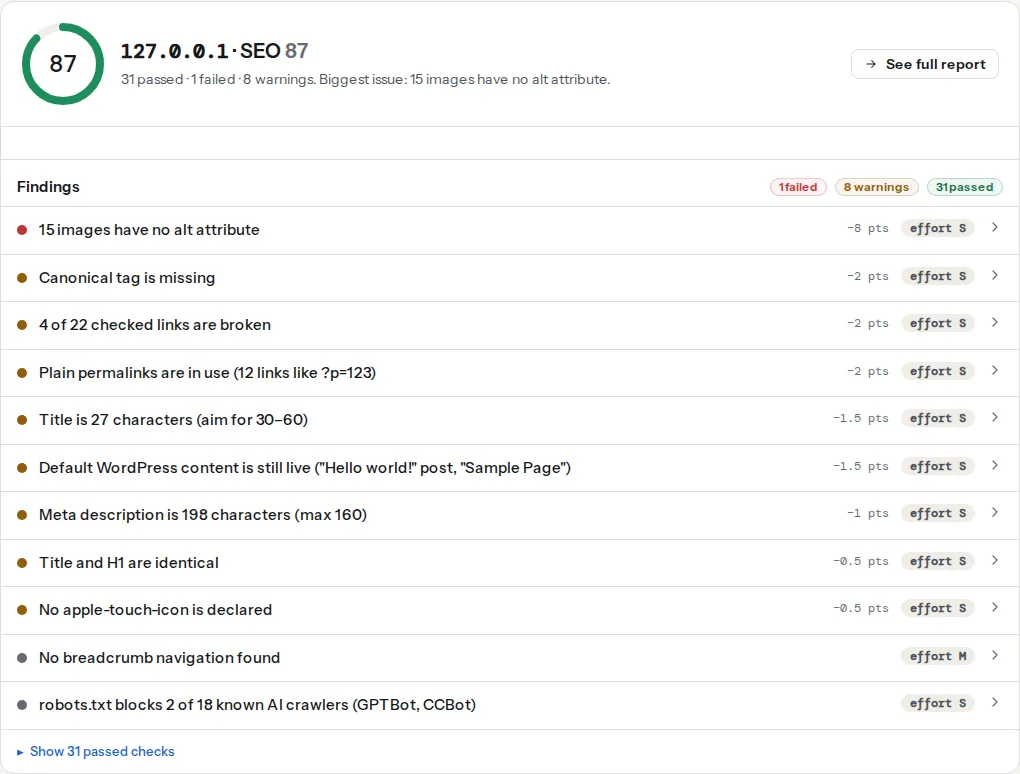
> **Check: Canonical tag is present.** Without a canonical URL, search engines may index duplicate versions of this page (with and without trailing slash, with UTM parameters) and split its ranking signals.
>
> 1. Add in .
> 2. In WordPress, Yoast or Rank Math add this automatically — check it is not disabled for this page.
The check reads the `` on the final URL. On a filter page the companion `canonical-self-or-valid` finding tells you where it points and whether that target answers 200; a canonical on `?sort=price` should point at the category, and a canonical on `/shoes/red/` should point at itself.
> **Check: The page is not set to noindex.** A noindex directive tells Google to drop this page from search results. Unless that is intended, every visit from search is lost.
>
> 1. Remove noindex from the robots meta tag and from the X-Robots-Tag header, unless the page should stay out of search.
> 2. In WordPress, untick Settings → Reading → "Discourage search engines" and check the page's SEO plugin settings.
On the multi-facet URL you decided to keep out, this finding *should* fail: a fail here is the confirmation that the `noindex` is in place. On the single-facet landing page it must pass. The check reads both the meta tag and the `X-Robots-Tag` header, so a `noindex` added at the web server for `?` URLs is seen.
> **Check: robots.txt allows this page.** A Disallow rule stops search engines from crawling this page, so they cannot read its content or see any updates. The page can still appear in results as a bare URL with no description.
>
> 1. Remove or narrow the Disallow rule in robots.txt so this URL is allowed for all crawlers.
> 2. If the page should stay out of search, allow crawling and use a noindex tag instead; a blocked page cannot be de-indexed.
Reports the robots.txt line that blocks the URL, and for which user agents. Run it on the multi-facet URL after adding a `Disallow` rule to confirm the pattern matches, and on the category and the single-facet page to confirm it does not. The classic wildcard mistake, `Disallow: /*?`, blocks every URL with a query string, including ones you want.
> **Check: URL length.** Long URLs are cut off in search results and hard to share by hand. Short, readable URLs get more clicks and fewer typos.
>
> 1. Shorten the slug to 3–5 meaningful words and drop tracking or session parameters from the canonical URL.
Warns above 100 characters. Multi-facet URLs get there fast (`?colour=red&size=42&brand=acme&sort=price-desc&page=2`), and long URLs are cut off in results and unshareable; the check is a hint that the URL should not be indexable at all, or that the single-facet form should be a short path.
## Step by step
### 1. List the parameters
Open the category in a browser, click every filter, sort and view control, and write down each parameter name that appears in the address bar. Then check a day of access logs in the [log analyser](https://getreport.app/tools/log-analyser): the "parameter URLs" share for Googlebot and the most-fetched URLs show which parameters the crawler actually spends time on, which is often a parameter you forgot (an old `?replytocom=`, a `?add-to-cart=`, a `?ref=`).
### 2. Classify each one
Use the table in the quick answer. The only judgement call is which single facets have search demand. Look at the queries the category already ranks for in Search Console; if "red shoes" and "shoes size 42" appear, those facets deserve pages. Brand and material usually qualify; sort order, price ranges and page size never do.
### 3. Fix the parameters themselves
Before adding any control, make the URLs consistent, or the controls multiply:
- **One order.** `?colour=red&size=42` and `?size=42&colour=red` are two URLs. Generate them in a fixed order, and canonicalise the other.
- **One spelling.** `red`, `Red` and `RED` are three URLs. Lower-case values.
- **No empty parameters.** `?colour=&size=42` is a fourth URL for the same page. Drop empty keys when building links.
- **No defaults in the URL.** `?sort=relevance` is the base page; the link should be `/shoes/`.
Filters applied with JavaScript that update the URL with `pushState` still produce URLs Google can find if they appear in `href` attributes. Filters that use URL fragments (`/shoes/#colour=red`) do not create new URLs for the crawler, which is the approach Google recommends when you do not want facets crawled at all.
### 4. Canonical: for sorts, views and tracking
Every variant that shows the same set of products as another URL gets a canonical pointing at that URL. For sorts and views that is the category; for tracking parameters it is the clean URL of whatever page carries them. The canonical is a strong hint, not a command, but for parameter variants Google follows it reliably because the content matches.
```html
```
Pagination is the exception: `?page=2` shows different products, so it is self-canonical, and blocking it hides the products only reachable from page 2 onwards. [Pagination after rel=prev/next](https://getreport.app/guides/pagination-after-rel-prev-next) covers the details.
### 5. noindex: for combinations that must stay crawlable for now
Multi-select combinations show a unique product set, so a canonical to the category is a lie Google may ignore. `noindex` is the honest control: the page is crawled, its links (to products) are followed, and it stays out of the index.
```html
```
Or at the web server, which covers every response including ones the CMS does not render. On nginx, inside the category `location`:
```nginx
# Two or more facet parameters → noindex header
if ($args ~ "(colour|size|brand)=[^&]+&.*(colour|size|brand)=") {
add_header X-Robots-Tag "noindex, follow" always;
}
```
`noindex` does not save crawl budget; Google has to fetch the page to read it. It is the right tool while single-facet pages are still being discovered through the combination pages, and the wrong tool as the only control on a very large shop.
### 6. robots.txt: for what should not be crawled at all
Once the pages you want indexed are linked from the category and listed in the sitemap, block the rest from being crawled. Google's [robots.txt parser](https://developers.google.com/search/docs/crawling-indexing/robots/intro) supports `*` and `$`; the patterns must allow the single-facet pages and block the combinations:
```text
# /robots.txt
User-agent: *
# sort, view and page-size variants: never useful to crawl
Disallow: /*?*sort=
Disallow: /*&sort=
Disallow: /*?*view=
Disallow: /*?*per_page=
# two or more facets in one URL
Disallow: /*?*colour=*&size=
Disallow: /*?*size=*&colour=
Disallow: /*?*brand=*&
# tracking
Disallow: /*?*utm_
Sitemap: https://example.com/sitemap.xml
```
A blocked URL can still appear in results as a bare address if other pages link to it, and a blocked URL cannot be de-indexed with `noindex` because the tag is never read. So the order is: `noindex` first, wait until the combinations have dropped out of the index (Search Console's Pages report shows it), then block. The [robots.txt patterns guide](https://getreport.app/guides/robots-txt-patterns-wildcards-allow-crawl-delay) has the matching rules in detail.
### 7. Build the single-facet pages properly
A filter page that should rank needs what any landing page needs: a short path (`/shoes/red/` rather than `?colour=red`), a unique title and H1 ("Red shoes" not "Shoes"), a paragraph of text that a visitor would read, a self-canonical, breadcrumb links, internal links from the category and the sitemap entry. Without those it is a duplicate with a nicer URL, and Google will fold it into the category.
### 8. Check what Googlebot does with it
Two weeks after the change, run the log analyser again: the parameter share of Googlebot's visits should fall, and the most-fetched URLs should be categories and products. Then paste a sample of 100 filter URLs of each type into the [bulk URL checker](https://getreport.app/tools/bulk-url-checker): the `noindex` column reads `yes` for the combinations, the `canonical` column shows the category for sorts and views, and single-facet pages show `no` and a self-canonical.
## Platform notes
### WordPress and WooCommerce
WooCommerce's own controls produce `?orderby=price`, `?min_price=10&max_price=50` and, with the layered navigation widget, `?filter_colour=red&query_type_colour=or`. Filter plugins add their own names. Yoast SEO and Rank Math build the canonical from the category's permalink, so sorted and filtered URLs already canonicalise to the base category; check one in the report to confirm your theme prints it. For `noindex` on combinations, a small filter in the theme's `functions.php` covers both plugins' output:
```php
// Add noindex on product category URLs that carry two or more filter parameters.
add_action('wp_head', function () {
if (!is_product_category()) return;
$facets = array_filter(array_keys($_GET), fn ($k) => str_starts_with($k, 'filter_'));
if (count($facets) >= 2) {
echo '' . "\n";
}
}, 1);
```
WooCommerce also emits `?add-to-cart=123` links on category pages; these should be blocked in robots.txt (`Disallow: /*?*add-to-cart=`) since each one is a crawlable URL that performs an action.
### Shopify
Collection filters use `?filter.v.option.color=Red`, `?filter.v.price.gte=10` and `?filter.p.vendor=Acme`; sorting uses `?sort_by=price-ascending`. The `canonical_url` object that themes print points filtered and sorted collection URLs at the plain collection, which handles sorts and combinations in one go; check a filtered URL in the [canonical checker](https://getreport.app/tools/canonical-checker) on your theme. Shopify's robots.txt is editable through the `robots.txt.liquid` template if you want to add `Disallow` rules for filter combinations. Single-facet landing pages are best built as separate collections (`/collections/red-shoes`) with their own description, since filter URLs cannot carry unique text.
### Magento
Layered navigation produces `?color=52&price=10-20`. Under Stores → Configuration → Catalog → Catalog → Search Engine Optimization, "Use Canonical Link Meta Tag For Categories" makes every filtered URL canonical to the category. Combine with robots.txt rules for the attribute parameters you never want crawled.
## Verify
- The report on a sort or view URL shows a canonical pointing at the category, and `indexable-status` on the category itself passes.
- The report on a multi-facet URL fails `robots-meta-noindex` (intended) or, after the block, fails `robots-txt-blocks-page` with the line you wrote; never both at once.
- The report on a single-facet landing page passes canonical, noindex and robots.txt, and lists the page in the sitemap.
- The log analyser shows Googlebot's parameter-URL share falling week over week.
- Search Console's Pages report: "Duplicate without user-selected canonical" and "Excluded by noindex" stop growing, and the single-facet pages appear under "Indexed".
## Common mistakes
- **Blocking everything with `Disallow: /*?`.** It also blocks pagination, search, and the single-facet pages you wanted. Write patterns per parameter.
- **`noindex` and a robots.txt block on the same URLs.** The block prevents the tag from being read, so the URLs stay indexed as bare addresses. `noindex` first, block later.
- **Canonical from a combination page to the category.** The product sets differ, so Google may ignore the canonical and index both. Use `noindex` for combinations.
- **Relying on `nofollow` on filter links.** Google treats `nofollow` as a hint and still discovers the URLs; Google's faceted navigation guidance says not to rely on it. Use the controls above.
- **Canonicalising page 2 to page 1.** Products on later pages lose their only crawl path. Pagination is self-canonical.
- **Fixing the controls but not the URL generation.** Two parameter orders and mixed case double every rule. Fix the links first. For the URL side of the problem, [URL length and structure](https://getreport.app/guides/url-length-and-structure-what-matters) is the companion guide.